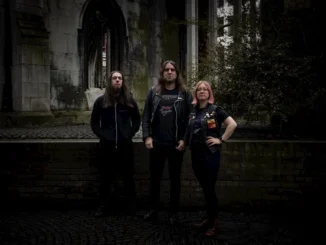
Album Review: Paradise Lost – Ascension
Reviewed by Sam Jones
Amidst the pantheon UK heavy metal, few bands of Paradise Lost’s calibre need an introduction. The legendary gothic/doom band, formed in 1988 out of Yorkshire, England, began with Demos the same year but shot to massive rapport with their 1990 debut album Lost Paradise, a success only cemented and amplified with their 1991 follow-up Gothic; a landmark record in the burgeoning Gothic Metal style. Through Shades Of God, Icon, Draconian Times, the 1990s saw Paradise Lost in their golden era and though the millennium’s dawn found bands straying away from their roots, Paradise Lost underwent a branch utilising electronica, hard rock and a softer sound retaining their identity. Their return to a classic sound can be found in 2015’s The Plague Within, a massive release bringing the spotlight upon the band to a new generation. Since then the band have dazzled us with 2017’s Medusa, 2020’s Obsidian, even re-recording Icon for an official thirtieth anniversary release. With no end in sight Paradise Lost rally themselves and fans for their eighteenth studio album, Ascension, due out September 19th via Nuclear Blast Records, their third record with the label. I can’t say No to Paradise Lost, I simply adore this band and they never quite make the same album twice. Let’s see what Ascension holds for us.
“Serpent On The Cross” was the first Single teased towards the album and i chose not to listen to it, desiring to go in totally blind. I fully understand why people praised it however for the whlst the band experimented a little with Obsidian, delving back into ideas used across the 2000s, Ascension seems to align more with The Plague Within and Medusa. The guitar tone is fat yet it does not throw itself upon us, maintaining enough distance to enable those melancholic vibes to travel, gain traction and thus bleed into the band’s songwriting. Paradise Lost possess the uncanny talent of giving their riffs simultaneous dread yet always present them as on the verge of tears; even during solos it’s like looking someone in the face you struggles, aspiring the minutest victory, still forging ahead in spite of the adversity; by all means they should have broken long ago but through grit and spite they lunge ahead. It’s this sensibility Paradise Lost perform with through Ascension. Granted this essence has long been a factor the past decade but Ascension brings it to the forefront with riffs mighty in weight, resonating with elongated sorrow, yet it is the magic of this band that their riffs don’t come off as wholly morose but the kind you beg to follow from record to record.
One element that remains prominent across the band’s modern catalogue is the application of Bass. Whether we’re dissecting the bass in the mix or the bass guitar, whose basslines are integral to the band’s melancholic punch, Ascension is a vast and far-reaching album that even during their nuanced and developing sections will hit with the force of a bulldozer, perhaps because the band are pulling back on the direct aggression. It’s often stated that, psychologically its the unsaid, undone, unacted elements of the human condition that destroy people, carving shapes into souls where character once dwelled. Similar ideas prevail herein for whilst the bass hits with rounded, smoothed tone, when the bass drums are delivered in force, the songwriting is free to go as ruthless or apathetic as it wishes because the overall impact the band deliver on shall not wane. But that’s the magic to Paradise Lost; they’ve often found ways to convey immense tragedy bundled in human nature through songwriting and sequences where brutality has not been the forgone solution.
 Buy on Vinyl
Buy on CD
Buy Digitally
Buy on Vinyl
Buy on CD
Buy Digitally
The vocals on Paradise Lost records have always been exceptional but Ascension applies particular magnification to them, rendering them greater clarity and focus on past records have attempted to do. Nick Holmes’ vocals, I swear, are a glistening wine for they seem to glow upon ageing. The depth his vocals attain and the health of those vocals are amazing when you consider the band are approaching their fortieth anniversary; its likely due to Holmes not narrowing his vocals down to a single delivery. Throughout their career Holmes’ vocals have been growling, clean, snarling, projected etc, the vocals have been as interchangeable as the band’s career and therefore his cords are unlikely to be as damaged as other notable extreme metal vocalists simply because Paradise Lost, having never quite made the same album twice, always altered the expectations of the vocals needed for the songwriting. The variety of vocals on the same album allows “Salvation” to pierce as deeply as “Lay A Wreath Upon The World”. They’re on the same record but ooze differing atmospheres since the vocals applied are so unique from the other, alleviating Ascension from the strain of repetitive track styles.
At every moment you listen to this record you know Paradise Lost are in total control of your faculties. Its due to the band’s innate, honed understanding of pacing that draws you so completely unto their grasp where they can throw whatever they’ve lined up at you. Regardless what track’s tone you’re listening to you know the band have your fullest attention because their pacing is thoroughly controlled. You get the idea every small turn, every rise in intensity, is meticulously positioned for some purpose. Given how long the band have been doing this now it comes as little surprise, but it returns to how varied tracks are throughout Ascension for you may receive a song such as “Tyrants Serenade” but the following piece will not exhibit a replication of that prior atmosphere. The record pushes beyond fifty minutes but you’ll feel in comfortable hands after the opening tracks, confident what’s to come will be of quality material; Paradise Lost have always harnessed a homely aesthetic that despite the crushing introspective nature of their music, people can completely lose themselves in their soundscapes. Its why fans, harbouring demons malicious enough to give Satan gooseflesh, are driven to harmony whilst listening to Paradise Lost for the band’s mood establishes an equilibrium between our own psychologies and the emotions emanating via their disciplined pacing.
In conclusion, I think Ascension is the best Paradise Lost record since Medusa. It manages to be heavy and morose, harnessing emotion and blunt-force strength without writing tracks that are all the same. A track you listen to at the start will not be the same track you experience towards the end for, as we’ve discussed, Paradise Lost saw to it they did not follow up a song with its mirror-reflection. Ascension is a deeply focused beast that pulls from both ends of mortality and melancholy to craft a record that manages to go harder and softer pending on the songwriting displayed. I like that the band didn’t just make each track as punishing as the last and included some genuine diversity; in a way Ascension is the love child of The Plague Within and Obsidian, culminating the preceding ten years with an opus that basks Paradise Lost with all their glory before a grey light. Its why the band are revered amongst the UK as one of its most consistently excellent bands, for no matter what aesthetic or techniques they imbue their work with they will always hit home with hard power derived from experiencing Life in its totality. Ascension, even its extended digisleeve with an additional two songs bringing the runtime to over an hour, stands as a pedestal depicting the towering reputation Paradise Lost have garnered across the decades. An astounding time is to be had with many of the band’s best and newest songs to boot. Highly recommended.
For all the latest news, reviews, interviews across the heavy metal spectrum follow THE RAZORS’S EDGE on facebook, twitter and instagram.